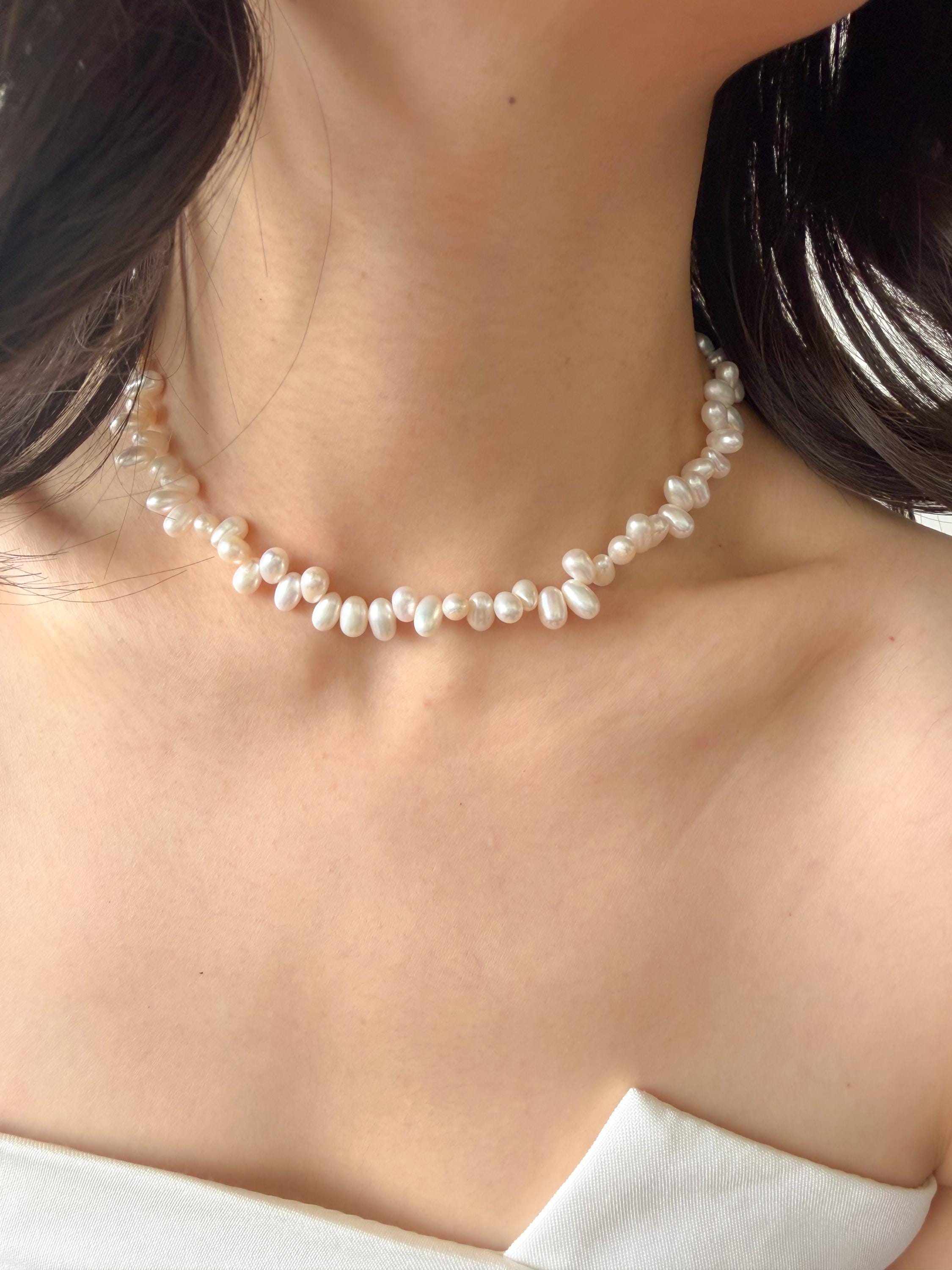
Baroque pearls are cultured pearls with irregular or asymmetrical shapes. Their curves, ridges, and unexpected silhouettes are part of their appeal—not evidence that they are automatically lower quality.
Baroque describes shape, not overall quality
The Gemological Institute of America identifies shape as only one of seven pearl value factors. GIA also evaluates size, color, luster, surface, nacre, and matching. It specifically notes that well-formed baroque cultured pearls can be prized by pearl lovers.
Independent reference: GIA Pearl Quality Factors and GIA 7 Pearl Value Factors.
Why every baroque pearl looks different
As nacre develops, a pearl may grow into an elongated, folded, oval, drop-like, or completely free-form shape. Those differences let designers work with each pearl individually rather than forcing every piece into perfect uniformity.
Interesting shape does not excuse poor quality
A dramatic outline may catch your attention, but it should still be accompanied by attractive luster, a sound surface, appealing color, and a form that suits the design.
What to inspect before buying
- Luster: Look for bright, lively reflections rather than a flat or chalky surface.
- Surface condition: Small natural characteristics can add personality, but cracks, peeling, or severe damage are different.
- Color and overtones: White pearls may show pink, cream, silver, or purple undertones.
- Design balance: In earrings or multi-pearl pieces, irregular pearls should feel intentionally paired, even when they are not identical.
- Clear photography: Close-up images should show the actual surface and shape rather than hiding them with heavy editing.
How we approach baroque pearls
At Le Jardin de Perles, unusual shape alone is not enough. We look for pearls whose natural individuality is supported by strong visual luster, attractive color, and a form that contributes to the finished design.
Baroque Pearls
One-of-a-kind forms selected for luster, beauty, and character.