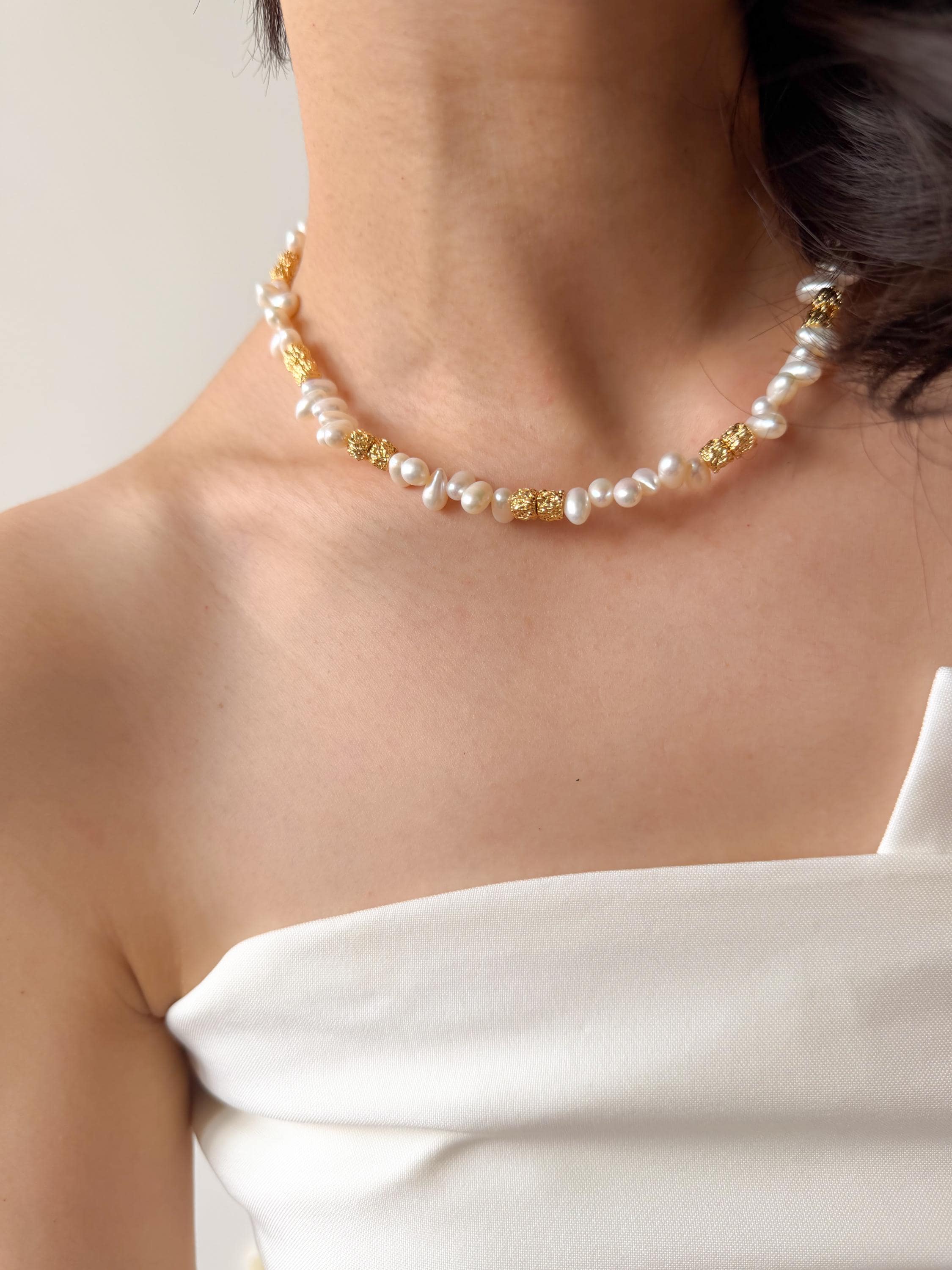
Pearls should be purchased with attention. Two pearls of similar size and shape can differ noticeably in brightness, surface condition, durability, and overall beauty.
1. Look closely at luster
Luster is the intensity and quality of light reflected from a pearl’s surface and from just beneath it. Pearls with strong luster show bright, crisp reflections. Pearls with weak luster may appear flat, cloudy, or chalky.
GIA notes that luster and nacre quality are closely related, and that a dull or chalky appearance can indicate thin nacre, affecting both appearance and durability.
Reference: GIA Pearl Quality Factors.
2. Understand surface character
Because pearls grow within living mollusks, completely featureless surfaces are uncommon. Small spots, ridges, or growth marks can be part of an organic pearl’s character. However, deep cracks, peeling, severe pits, or damage around drill holes are different from gentle natural variation.
3. Do not confuse roundness with quality
Round shape can be rare and valuable when other factors are equal, but shape alone does not establish quality. GIA specifically recognizes that well-formed oval, pear, and baroque cultured pearls may also be prized.
Reference: GIA Pearl Quality Factors.
4. Examine color and overtones
Color includes the pearl’s dominant bodycolor and the subtler colors that appear across its surface. Freshwater cultured pearls may naturally show white, cream, pink, orange, or purple hues. Choose color for beauty and harmony—not simply because a listing calls a pearl “white.”
5. Consider nacre and durability
Nacre is the material deposited by the mollusk to form the pearl. Its quality contributes to luster and durability. Nacre cannot always be fully assessed from a photograph, which is why trustworthy descriptions, realistic imagery, and reputable sellers matter.
6. Look for thoughtful matching
In a strand, pair of earrings, or multi-pearl design, matching considers how pearls relate in size, shape, color, luster, and surface. Matching does not require perfect sameness. Baroque and asymmetrical jewelry can be deliberately varied while still looking balanced and intentional.
7. Read the description carefully
The Federal Trade Commission advises sellers to disclose whether pearls are cultured or imitation. Natural pearls are very rare, and most pearl jewelry contains cultured or imitation pearls. A seller should use clear terminology instead of relying on the unqualified word “pearl” or a vague luxury label.
References: FTC Consumer Advice and FTC business guidance on advertising pearls.
A single grade or marketing term cannot tell the whole story
Because recognized pearl evaluation involves several separate factors, do not choose only by size, roundness, a seller-created grade, or the words “premium” and “high quality.” Look for evidence in the photographs and details.
Questions worth asking before purchasing
- Are the pearls cultured, natural, or imitation?
- Are the photographs of the actual piece or a representative sample?
- What are the pearl dimensions at the widest and longest points?
- Are colors natural, treated, dyed, coated, or otherwise enhanced?
- What metal and finish are used in the setting or chain?
- Are natural variations and significant surface characteristics clearly shown?
- For earrings, will the pair be similar or intentionally asymmetric?
Our selection philosophy
At Le Jardin de Perles, we use these same qualities as a guide—particularly visual luster, attractive color, surface character, and thoughtful pairing. We do not believe every pearl should look identical. We do believe its individuality should be matched by beauty and honest presentation.
Explore our freshwater cultured pearls
Every piece includes close photography, dimensions, and natural-variation details.
Independent sources
- Gemological Institute of America — The GIA 7 Pearl Value Factors
- Gemological Institute of America — Pearl Quality Factors
- Gemological Institute of America — Pearl Buyer’s Guide
- Federal Trade Commission — Buying Gemstones, Diamonds, and Pearls
- Federal Trade Commission — In the Loupe: Advertising Diamonds, Gemstones and Pearls